


God and Reason (16)
One thing I have desired of the LORD,
That will I seek:
That I may dwell in the house of the LORD
All the days of my life,
To behold the beauty of the LORD,
And to inquire in His temple. Psalm 27.4
Made for beauty
It’s not something we think of very deeply, or even very often. But people were made for beauty. We were created to experience and appreciate beautiful things in all kinds of ways: “And out of the ground the LORD God made every tree grow that is pleasant to the sight and good for food” (Gen. 2.15).
In Psalm 27.4, the word translated “beauty” is actually “delightfulness” or even “pleasantness”. Things beautiful are experienced as delightful and pleasurable. In His temple, amid the praises and singing of departed saints and holy angels, the Lord Jesus Christ is beautiful, and not just to behold, but to experience—to be near, to see Him seeing us, to rejoice in His steadfast love and faithfulness, to marvel at His immensity, to be drawn into the experience of His joy. Yes, beautiful. Indeed, the very standard of things beautiful.
Most of us would probably admit that we can’t really define beauty, but we know it when we see it. Things beautiful strum a chord of pleasure in our soul. If our soul is pure and set on the Lord, then the beauty we behold and experience as delight and pleasure will be just what He intends. But we must guard our soul against being wooed by the lies of the devil and thinking things beautiful which are really corruptions of beauty designed to poison our soul and divert us from the path of righteousness.
And this is where reason comes in. As our powers of reason are being shaped by prayer and conversation with our fellow believers—and our daily converse with God in His Word and prayer—we will increase in our ability to apply reason to a great many matters, among them the question of beauty and delightful.
And one place to practice our reason with things beautiful is the arts.
Approaching the arts
While our focus here will be on painting, all the arts—music, sculpture, literature, architecture, and more—can provide good exercise for our reasoning powers. My approach to the arts is to ask questions. The more questions I ask, the more I enter the various features of a work of art to discover why I find this painting (or composition or poem) so delightful to study, so pleasant to view. And the more I exercise my reasoning powers.
Here are some questions you can use to begin exploring a work of art:
- Who is the artist? What do I know him or her?
- What is the title of this piece? Why does it seem to be titled this way?
- What is the theme of this composition, it’s main “story”?
- What aspects of the composition stand out?
- What do these suggest?
- How do such things as color palette, arrangement of features, and title help me think about the artist’s main idea in painting this delightful work of art?
- What about this painting do I find pleasurable? Or put another way, how does this painting speak to me, and why?
An example from Andrew Wyeth
Let’s look at one painting together and use these questions to discover the beauty of it. Here is “The Writing Chair” by Andrew Wyeth (dry brush, 1961):
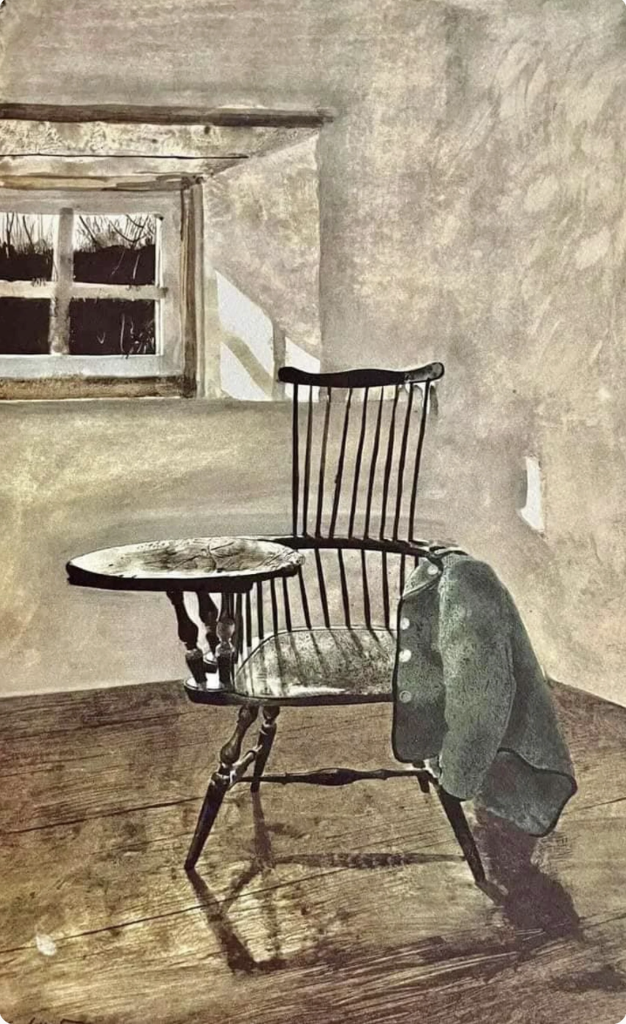
The title clearly indicates the theme. This is a Windsor writing chair, all alone in what appears to be an otherwise unfurnished room, a light green jacket draped over its left arm. A window in the background opens on a brown scene, together with the jacket suggesting a late fall or early winter setting. Wyeth is well known for these drab, brown and green colors, as well as for his dry brush technique, in which the water is squeezed out of the brush before it is applied to the canvas.
No writing implements are present. What does this suggest? The “writing chair” is being used rather like a coat rack than a place of literary creativity. What is Wyeth trying to say about writing? About art in general? Does this apply to other areas of life? Does this chair represent a calling, like a calling to art or to writing? A lonely calling, for sure, as all callings can be. And it might seem late in life—fall or winter—to be thinking about something like this, but the chair is there—like the grace of God?—ready for us to bring our creativity and tools and take our seat in this calling.
That’s as much as we can say in this small space. I find this painting delightful, pleasurable, and beautiful for a variety of reasons. A print of it has hung over my workspace for more than twenty years. It stimulates my thinking and guides my reason in many ways, as I hope it does yours. And it’s an example of how paying attention to the arts can exercise and strengthen our powers of reasoning.
For reflection or discussion
1. As you look at this painting, how do you experience your reasoning powers becoming engaged?
2. Do you find this painting beautiful? Why or why not? What reasons can you give?
3. How can studying a work of art like this sharpen our reasoning skills for serving the Lord?
Next steps—Preparation: Find a painting that you consider beautiful. Study it carefully to practice using your reason in understanding this painting and why it gives you pleasure.
T. M. Moore
If you have found this meditation helpful, take a moment to give thanks to God. Then share what you learned with a friend. This is how the grace of God spreads (2 Cor. 4.15).
You can learn more about my view of “The Writing Chair” in my essay, “Wait Time”, which is found in our book, Vantage Point. You can order Vantage Point by clicking here.
This week: Our Read Moore podcast continues readings from the book, The Joy and Rejoicing of My Heart. In our Crosfigellteaching letter, we are studying examples of the spiritual poetry of the Celtic Revival. And in the daily Scriptorium column we are working our way through the Gospel of Matthew. Click here to see all the other columns and writers available to you.
And please prayerfully consider supporting The Fellowship of Ailbe with your prayers and gifts. You can contribute online, via PayPal or Anedot, or by sending a gift to The Fellowship of Ailbe, P. O. Box 8213, Essex, VT 05451. Except as indicated, all Scriptures are taken from the New King James Version. © Copyright 1982 by Thomas Nelson, Inc. Used by permission. All rights reserved.


