


Peter Huntoon: “Battenkill Barn”
In this fallen world, our ability to perceive and enjoy beauty is impaired by many things, and the beauty in all that surrounds us can be easily obscured.
One of the important contributions artists make is helping us see the beauty in things that might not at first sight seem all that beautiful. Most of art deals with everyday situations and things. There’s beauty in them, but mostly, we don’t stop to see it. The artist—whether in painting, sculpture, music, poetry, or other forms—sees something we don’t, and he wants to show us what he’s seen by creating a work of beauty which we will pause to consider.
For example, an old barn sitting beside a lazy river isn’t exactly an everyday thing, but we’ve seen enough of such scenes that we probably wouldn’t pause to study it, or try to explain any beauty we might see:
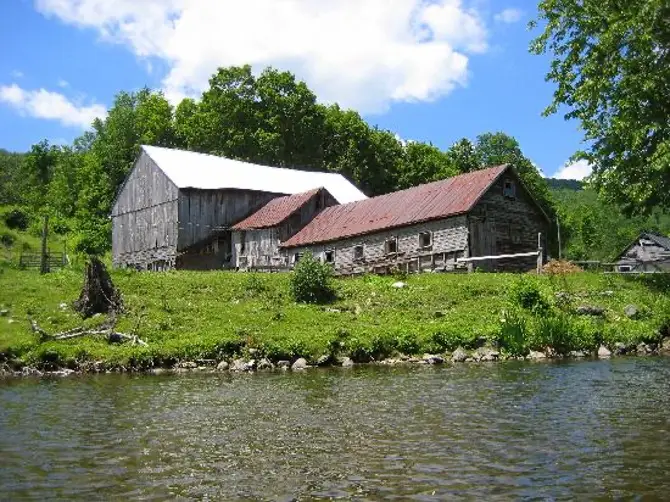
And that’s just the difference between us and an artist like Peter Huntoon. Not only does Huntoon find beauty in this old barn, but he brings it out in “Battenkill Barn” for us to appreciate and enjoy::
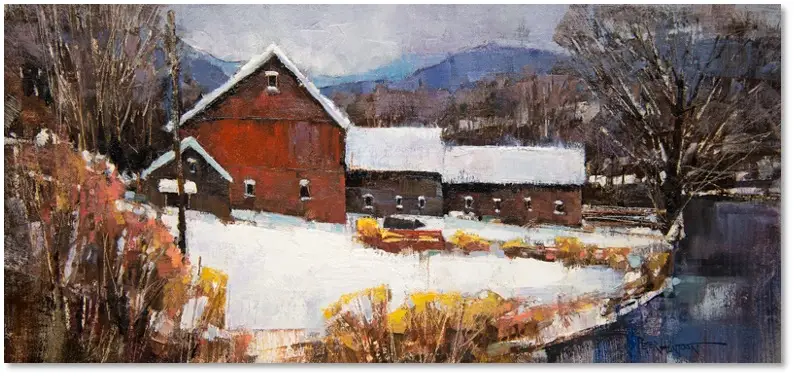
Huntoon sets his painting in winter. It’s cold and dreary. But that barn is so bright and cheery, the snow is similarly bright, and the yellows, blues, oranges, and even the darker blacks and browns remind us that winter has its own beauty. And so does this old barn.
Peter Huntoon frequently paints water. If you “read” this painting left to right, you see that the lines are descending toward Battenkill River. From the brown trees on the left, follow the roof top, after its highest peak, and the lines suggested by the slope of the snow and what looks like bales of hay. We end up in the blue Battenkill. We are drawn to water. We can’t live without it.
Water is life. Winter doesn’t seem very lively, but it has beauty and life of its own. Snow puts in relief seasonal beauty that we might otherwise miss—like the snow lying on the limbs of the trees and the rooftops. Huntoon uses the snow to draw out the beauty of the whole scene, which he further emphasizes with the colors he uses and, not to be ignored, the one cow out for a snack.
The mountains in the background present a contrast to the barn in color, slope, and shape. We sense there is beauty to be found there, too. Their beauty is sublime, even mystical, and thus creates a contrasting setting for the more earthly and wintry beauty of the barn.
This a good example of what we might call found beauty. Beauty is everywhere around us, but sometimes we need the artist’s touch to help us see it. By studying works of art which bring out the beauty of everyday things, we can become more aware of that beauty all around us. And the art of Peter Huntoon can help us in this effort.
If you’re not a subscriber to Peter’s newsletter, “A Day in Vermont”, I encourage you to visit his website and join with the many who share in his love for beautiful things.
T. M. Moore